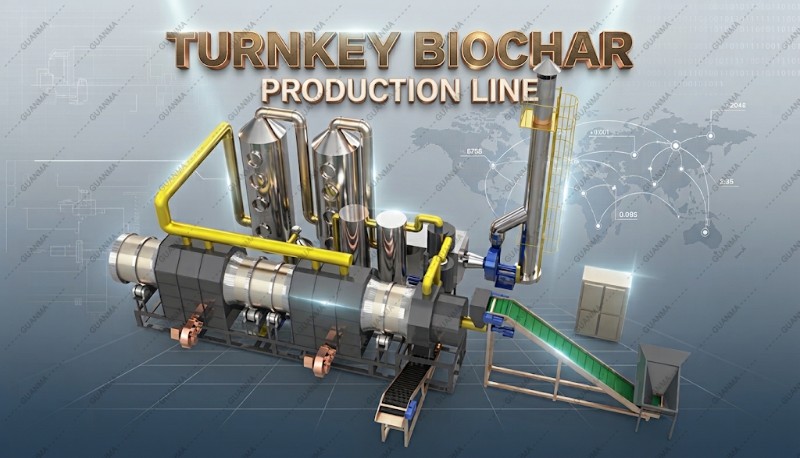
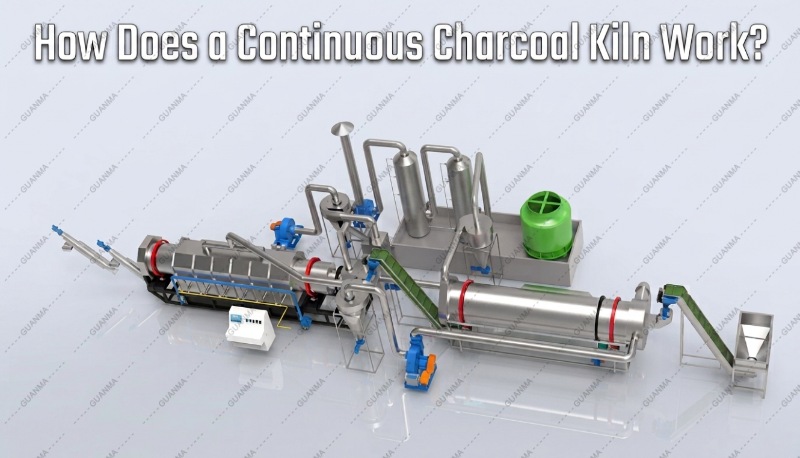
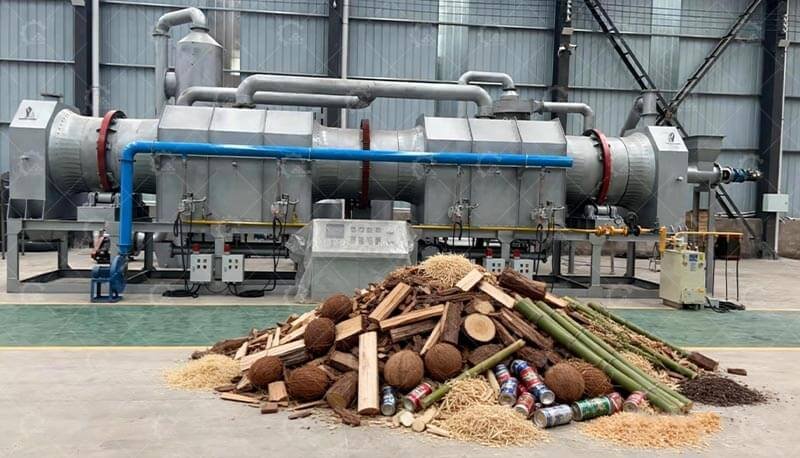
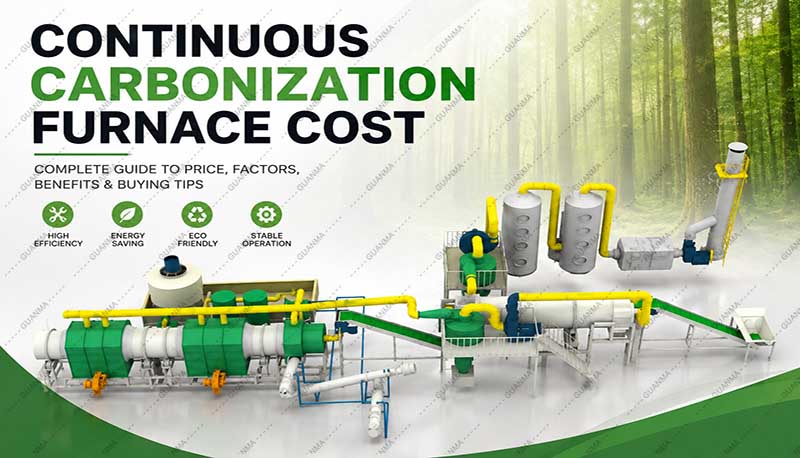
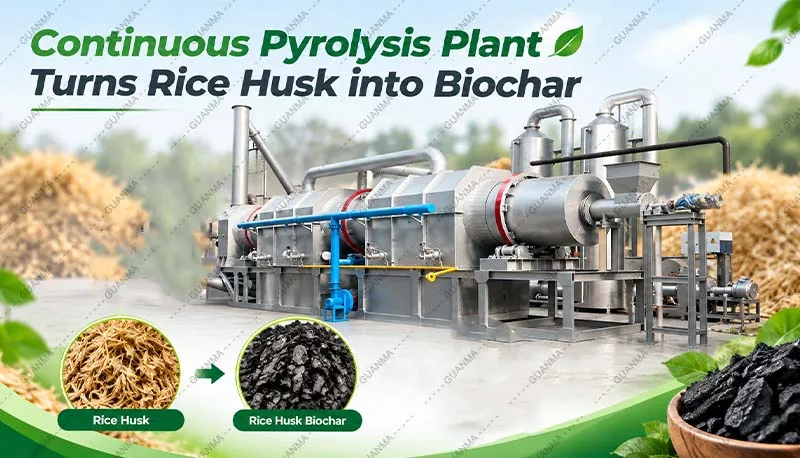
A continuous pyrolysis plant for biochar production from rice husk is an industrial system that converts rice husk into carbon-rich biochar through continuous thermal decomposition in a low-oxygen environment. It also produces syngas that can be recycled to heat the reactor, reducing external fuel costs.
How a Continuous Pyrolysis Plant Turns Rice Husk into Biochar
1. Feeding and Drying
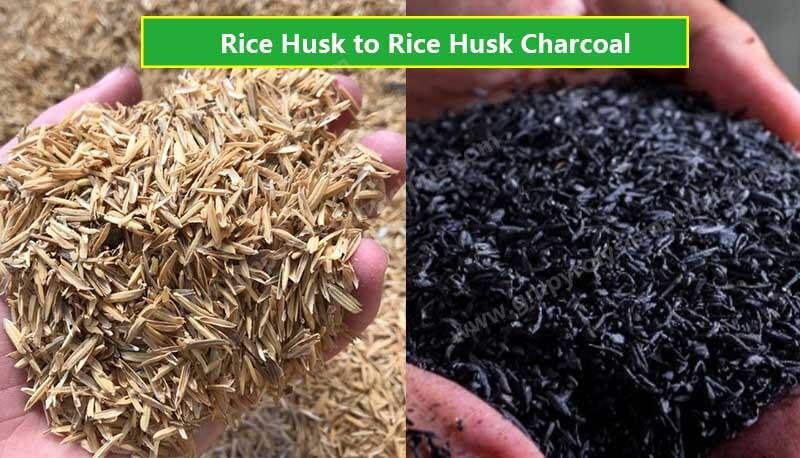
Rice husk is fed into the system and dried to reduce moisture. Stable moisture helps control pyrolysis temperature and final biochar quality.
2. Pyrolysis in a Low-Oxygen Reactor
Inside the continuous carbonization pyrolysis machine, rice husk is heated to roughly 400–600°C in a low-oxygen atmosphere. Volatile matter is released as syngas and bio-oil vapor, while fixed carbon remains as biochar.
3. Biochar Discharge and Cooling
Hot biochar is discharged through a cooling system. Cooling prevents re-ignition, improves safety, and prepares the biochar for packing or further processing.
4. Syngas Recycling and Emission Control
The syngas produced during pyrolysis can be burned to heat the reactor. This reduces fuel costs. Flue gas should pass through dust removal, scrubbers, or other emission control equipment to meet local regulations.
Key Benefits of Continuous vs. Batch Pyrolysis for Rice Husk
Higher Throughput and Stable Output
A continuous pyrolysis plant can run 24/7 with minimal downtime. Output is more consistent.
Lower Labor and Energy Costs
Automation reduces manual feeding and discharge. Reusing syngas lowers external energy demand.
Better Biochar Quality
Continuous temperature control produces rice husk biochar with stable carbon content, pH, and particle size—important for agriculture and industrial buyers.
Scalable Design
Systems can be designed for small rice mills or large industrial projects. Capacity may range from hundreds of kilograms per hour to several tons per hour.

What Can You Do with Rice Husk Biochar?
Soil Amendment and Carbon Sequestration
Rice husk biochar improves soil water retention, nutrient holding, and microbial activity. It also locks carbon in the soil for long periods.
Water Filtration and Environmental Remediation
The porous structure and silica content make rice husk biochar useful for filtering contaminants and improving water quality.
Silica and Activated Carbon Production
With further processing, rice husk biochar can be used as a precursor for activated carbon, silica, or silicon-based materials.
Fuel and Briquette Additive
Biochar can be blended into briquettes or used as a solid fuel in some applications, depending on quality and local demand.
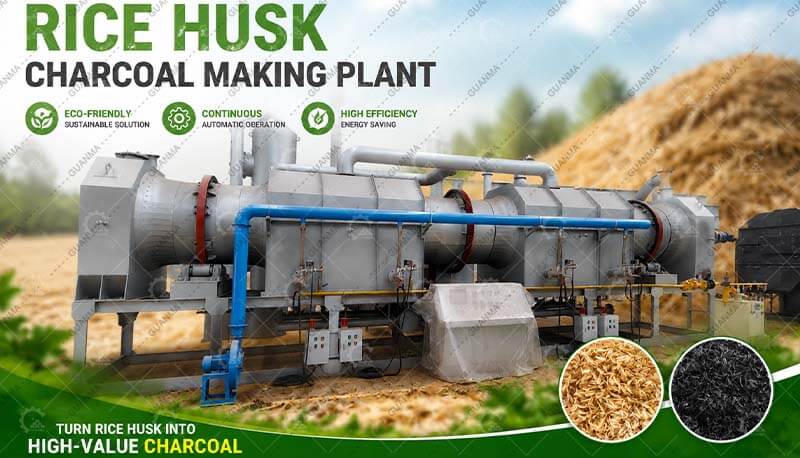
How to Choose the Right Continuous Carbonization Pyrolysis System
Test Your Rice Husk First
Feedstock properties vary by region and milling process. Ask for a pyrolysis test to confirm biochar yield, quality, and potential challenges.
Check Reactor Design for High-Ash Biomass
Not every pyrolysis reactor handles rice husk well. Look for anti-clinker features, wear-resistant materials, and reliable ash discharge.
Confirm Capacity and Automation Level
Match capacity to your rice husk supply. Consider PLC control, remote monitoring, and automatic temperature regulation.

Review Emission Control and Compliance
Ask about flue gas treatment, dust collection, and local environmental standards. A compliant plant avoids costly shutdowns.
Evaluate After-Sales Support
Installation, training, spare parts, and technical support are critical. A good supplier helps you ramp up and maintain production.
Start Your Rice Husk Biochar Project Today
A continuous pyrolysis plant for biochar production from rice husk can solve waste disposal, reduce energy costs, and create valuable biochar products.
If you are planning a rice husk biochar project, Contact Guanma Machinery today for a customized continuous pyrolysis plant solution.
📩 Get Your Free Quote Today
Contact us today to discuss your project, capacity requirements, and target materials. Our team will reply within 24 hours with a customized proposal. You can also reach us directly at guanmarecycle@gmail.com — we are here to help!